

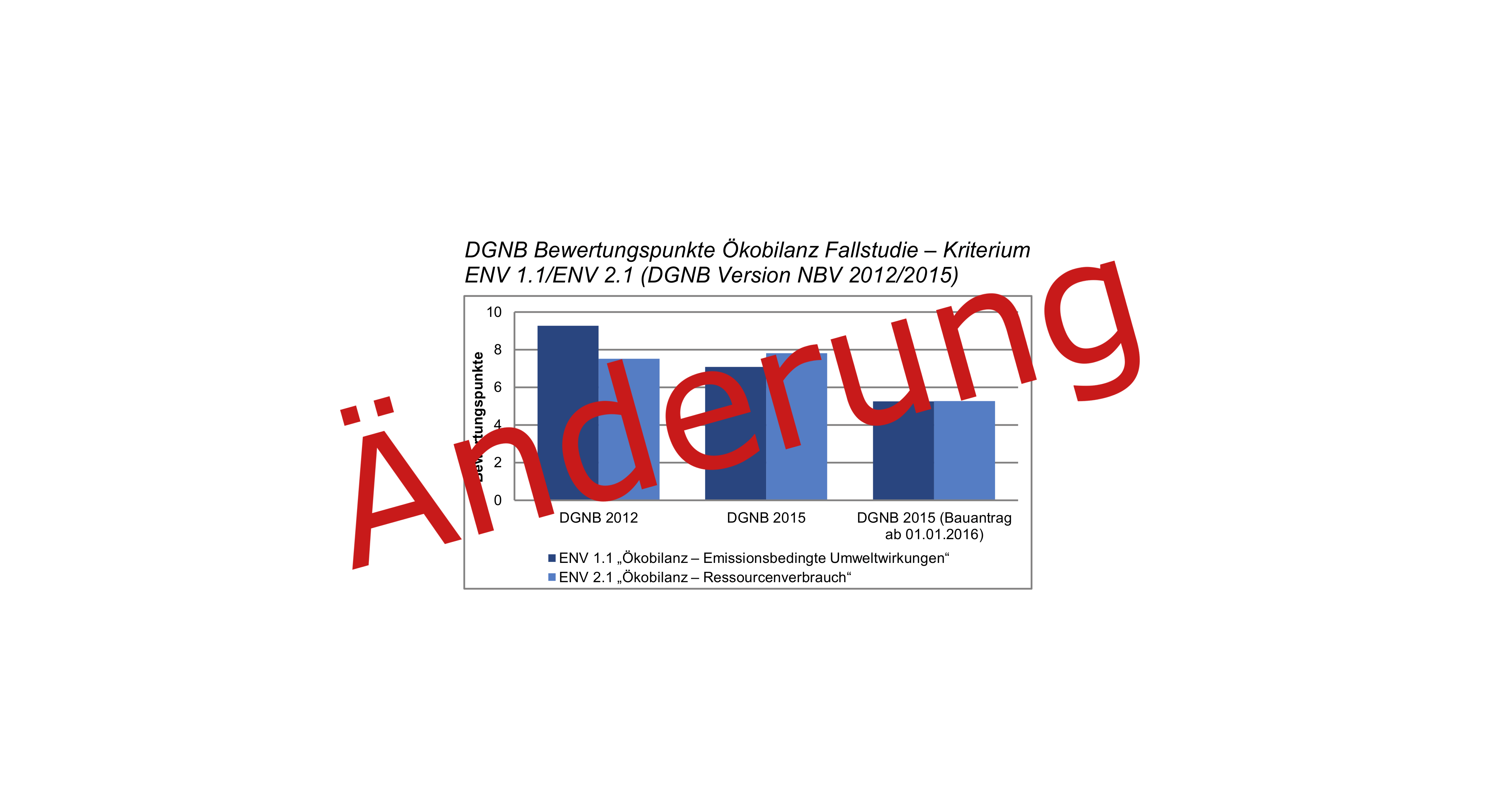
12.05.2016 In a position paper, the DGNB commented on the 25 percent tightening of the annual primary energy requirement for buildings in accordance with the EnEV (building application from 01.01.2016) and called for a reorientation of the EnEV taking into account the life cycle assessment of the building construction. At the same time, the DGNB informed its members and auditors that it has decided against adjusting the reference values in the life cycle assessment criteria (ENV 1.1 and ENV 2.1) as a result of the tightening.
Shortly after the publication of our report “Life cycle assessment in the DGNB 2015 system – innovations, stricter requirements and potential – results of a case study” on April 20, 2016, the DGNB also reacted to the loss of points in the life cycle assessment criteria due to the tightening of the EnEV 2014 (building application from 01.01.2016).
Our study was based on the DGNB NBV 2015 version valid at the time. The new data records of ÖKOBAUDAT 2013 or the more recent version (currently ÖKOBAUDAT 2015) must be used. There are also legal changes. These include the replacement of the outdated Energy Saving Ordinance (EnEV) 2009 by the EnEV 2014. In accordance with the previously valid ENV 1.1 and ENV 2.1 criteria, the 25% tightening of the EnEV requirements from 2016 also applies as a reference value for the DGNB 2015 version. (as of 20.04.2016)
Using a representative three-storey administration building in reinforced concrete construction, we were able to determine that the tightening of the EnEV resulted in a loss of 4.5 % points in the overall DGNB assessment. The project was certified in accordance with DGNB NBV 2012 and achieved a weighted average score of 8.55 (out of a maximum of 10 achievable) points for the ENV 1.1 and ENV 2.1 criteria. In the DGNB 2015 version, however, the same building only achieved 5.3 points. The high loss of points resulted from the stricter requirements in accordance with EnEV from 01.01.2016 and the resulting reference values.
The DGNB is now adjusting the life cycle assessment criteria accordingly and is against adjusting the reference values by tightening the annual primary energy requirement by 25 % in accordance with the EnEV for buildings with a building application from 01.01.2016. In our view, this makes sense, as it does not change the reference value within the DGNB NBV 2015 version and the projects are better or worse in terms of their life cycle assessment depending on the date of the building application. In particular, the DGNB is calling for the EnEV to be expanded to include a holistic view of a building with regard to its life cycle assessment, as the focus on reducing operating energy is no longer in keeping with the times.
After adjusting the ENV 1.1 and ENV 2.1 criteria accordingly, the following conclusion can be drawn based on our study “Life cycle assessment in the DGNB 2015 system – innovations, stricter requirements and potential – results of a case study”: Due to the change in the eco-construction data sets and the introduction of EnEV 2014 (without tightening), a loss of 1.6 % of points in the DGNB overall assessment must be taken into account. At the same time, the influence of materials through production, replacement and disposal on the overall eco-balance increases to up to 40 %. The use of ecologically optimized constructions and materials is therefore becoming increasingly important. For the future, this means taking greater account of sustainable building products and optimizing the building design during the planning phase.
Here you can read all the details of our results in the report “Life cycle assessment in the DGNB 2015 system – potentials through optimization of the building construction – results of a case study” >> Download
If you have any questions regarding life cycle assessment, we will be happy to assist you >> Contact