

Certified Good Mobility – Mobility as an integral part of sustainable building development
With Certified Good Mobility is a special standard that recognizes mobility and logistics as an integral part of a sustainable construction and real estate concept. The Good Mobility Council certifies neighborhoods, new buildings and existing buildings with regard to their mobility quality – so that mobility is no longer a secondary but a main subject in building planning.
How does Good Mobility certification work?
The procedure for obtaining Good Mobility certification is divided into the following steps:
- Target definition & specifications: Together with a Good Mobility Fellow, a project-specific specification sheet is drawn up – with clearly defined objectives, usage requirements (e.g. residential, commercial, neighborhood) and the desired certification level (bronze, silver, gold, platinum).
- Planning draft and optional pre-check: An initial check of the preliminary design can determine how likely it is to achieve a certain certification level and what optimizations may be necessary.
- Optimization and planning: The design is optimized based on the findings from the pre-check – the Fellow provides support if required. Goal: planning that fulfills mobility criteria in the best possible way.
- Registration and pre-certification (pre-certified): The planning is registered for pre-certification. After submission of the planning documents and/or letters of intent (LOI) for planned measures, the Good Mobility Council checks these for conformity and, if applicable, awards a pre-certificate with a corresponding certificate.
- Completion and full certification: After construction or conversion, the measures are completed and documented. After inspection of the completed property, either the certification or the optimization phase takes place if the desired certification level has not been achieved.
- Survey of the mobility KPIs: For certification, a monitoring phase takes place 6-12 months after occupancy: user mobility behavior is surveyed – important for transparency and proof of mobility quality.
- Full certification: After a successful audit and KPI survey, the Good Mobility Council hands over the final certificate.
This structured process ensures that mobility is not only planned, but also actually lived and tested.
What criteria are used to assess Certified Good Mobility?
The Good Mobility Standard evaluates projects according to use (office, residential, neighborhood, etc.) along various thematic test fields. The following categories are used for the certification of office or commercial units:
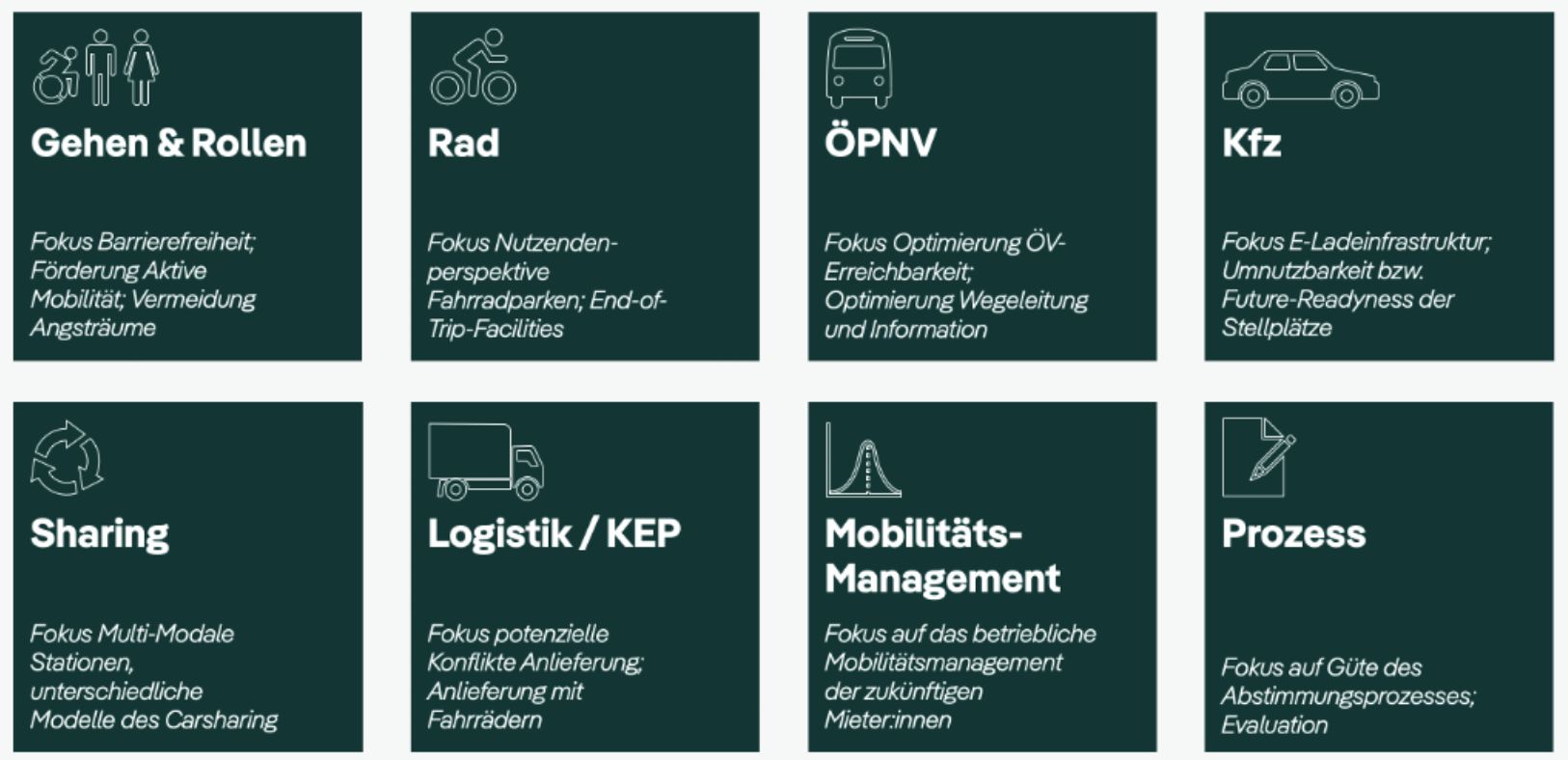
- Walking & rolling – Accessibility, pedestrian routes, promotion of active mobility, orientation & accessibility.
- Bicycle – High-quality and user-friendly bicycle parking spaces, e-bike infrastructure, long-term and short-term parking spaces, convenient access.
- Public transport connections – Alignment of the building or site to public transport stations, good accessibility, “last mile” concepts.
- Car parking spaces & infrastructure – Adequate number and quality of parking spaces, electromobility infrastructure, optimized parking space concepts.
- Sharing & mobility stations – Planning and integration of car sharing, e-scooters, mobility stations, parcel stations and multimodal services.
- Logistics – Delivery, delivery, parcel acceptance, cargo-specific logistics – ideal for urban neighborhoods with high usage density.
- Mobility management / use – Offers and services for residents and users, mobility partnerships, sustainable user guidance and information.
- Strategy & process – Anchoring in municipal goals, long-term mobility concepts, transparent target and reporting values, participation of urban society.
Good Mobility Fellows – Auditors for Certified Good Mobility
The certification is accompanied by trained auditors: the so-called Good Mobility Fellows. These fellows are independent planning experts – architects, transport planners or mobility consultants – who have been certified in training courses lasting several days. They advise and support project developers right from the start. They also identify mobility potential and support the planning process with their expertise. This ensures that every building or neighborhood is planned in a mobility-friendly, climate-friendly and user-oriented way – independently and on the basis of high professional standards.
Phone +49 711 62049-340
Email info@hoinka.com